Key Takeaways
- 1Revisions are different from refinements - revisions are avoidable rework, refinements are clinically necessary adjustments.
- 2High revision rates are a shared outcome between planners, doctors, and the production workflow.
- 3Most avoidable revisions originate at case intake when key information is missing.
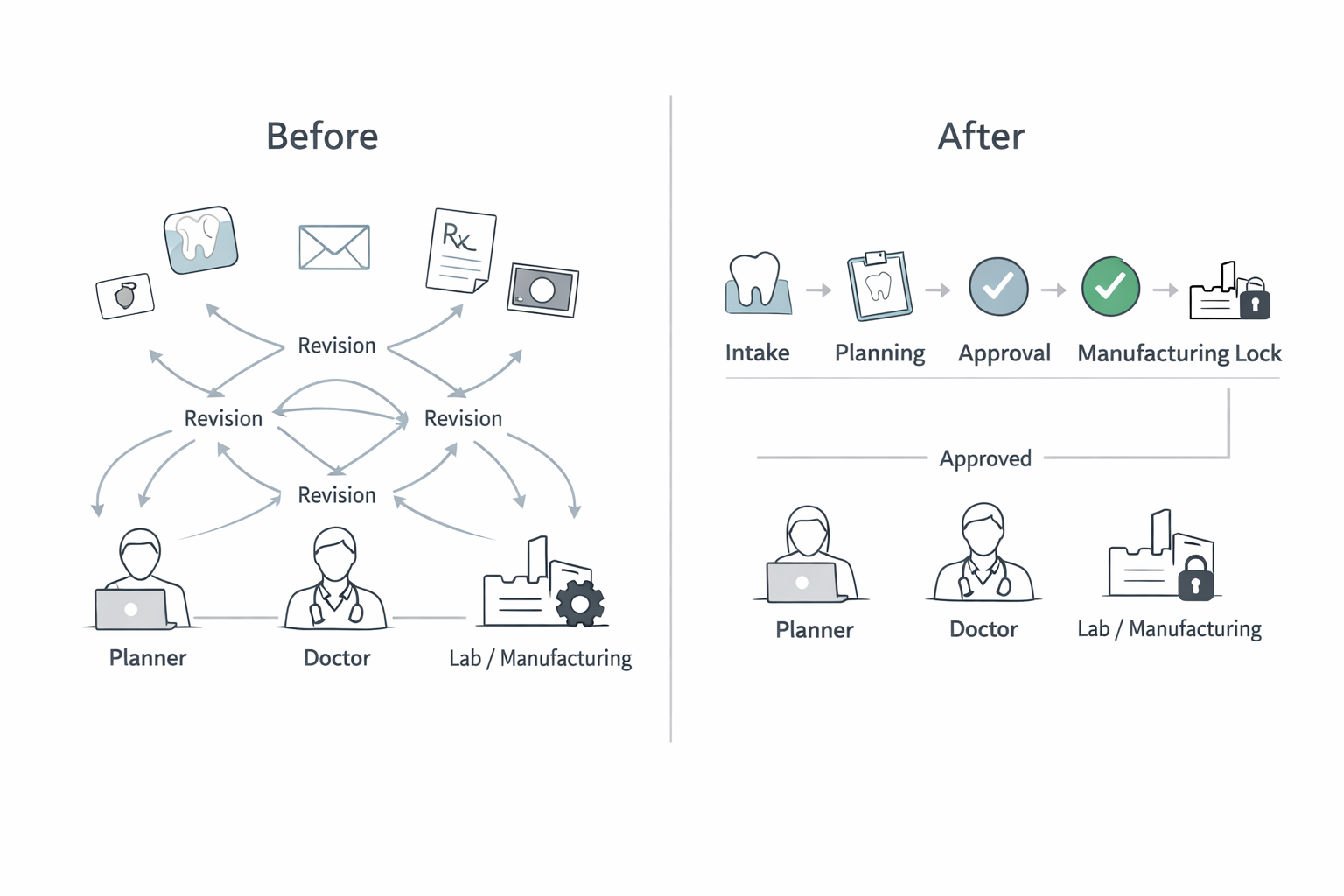
- 4A structured workflow with clear handoffs and manufacturing lock points reduces revisions naturally.
- 5Tracking revision types separately (planning, treatment, manufacturing) helps teams improve the right part of the workflow.
Most revisions are not random, and they are not the responsibility of planners alone.
Revision rates are a shared outcome between planners, doctors, and the wider production workflow. When clinical intent, expectations, or constraints are unclear at any stage, revisions are the natural result.
Before talking about how to reduce revision rates, it is important to clearly define what we mean by revisions.
Revision vs Refinement: Why the Difference Matters
A refinement is a clinically necessary adjustment that happens later in treatment, after aligners have been worn and real biological response can be assessed. Refinements are part of good orthodontic care and are not a failure of planning or communication.
A revision refers to avoidable rework caused by missing information, unclear decisions, or misalignment earlier in the workflow. Revisions usually happen before or shortly after plan approval and often create delays without improving patient outcomes.
When we talk about reducing revisions in this article, we are referring only to avoidable revisions, not clinically appropriate refinements.
The Three Types of Revisions That Matter
Not all revisions are the same. In practice, they usually fall into three categories.
1. Planning Revisions
These occur during case setup and approval. They are often triggered by incomplete records, unclear prescriptions, late preference changes, or predictable biomechanical issues that were not addressed early.
2. Treatment-Related Revisions
These happen after planning approval but before or during treatment. Some are unavoidable, but many stem from expectations that were not aligned during planning.
3. Manufacturing-Impacting Revisions
These occur when changes interrupt production. They require files to be regenerated or reprocessed and affect planners, doctors, labs, and manufacturers. These are usually the most costly revisions.
High revision rates are often a mix of all three. Reducing them starts with understanding where they originate.
Most Avoidable Revisions Start at Case Intake
Case intake sets the ceiling for plan quality. Doctors play a critical role here, and planners depend on this information to translate intent into a workable plan.
Before a case begins, the following should be clear:
- Upper and lower scans are clean and usable
- A stable bite is provided
- Required photos are included
- The treatment goal is clearly stated
- IPR expectations are defined or explicitly delegated
- Attachment preferences are stated or open to recommendation
- Any constraints are noted, such as implants or periodontal concerns
If key information is missing, planners should pause and ask. Designing without clarity almost always leads to a revision later.
A Short Decision Pause Improves Plan Quality
Before staging or placing attachments, planners should take a moment to answer three questions:
- What is the primary clinical goal of this case?
- Where is anchorage coming from?
- Which movement carries the highest risk or uncertainty?
This small pause leads to more intentional designs and fewer downstream changes.
Expectation Mismatches Drive Many Revisions
Many revisions are not clinical problems. They are expectation mismatches.
Doctors may expect fewer attachments, different IPR timing, or alternative staging without explicitly stating this early. When those expectations surface only after seeing the plan, revisions follow.
Planners can reduce this by including a short explanation with the first submission. A strong first submission includes:
- Key treatment decisions
- Attachment strategy and reasoning
- Known trade-offs or limitations
- One clear approval question
Example: "Please confirm you are comfortable with posterior anchorage and limited expansion before proceeding."
Many Biomechanics-Driven Revisions Are Predictable
Some revisions are triggered by issues that could have been anticipated. For more on these common issues, see our article on common planning mistakes.
Common examples include aggressive movements, unclear IPR sequencing, attachment choices that do not match the intended movement, or unspoken compromises between predictability and aesthetics.
Ways to reduce these revisions include:
- Using conservative movement limits by default
- Clearly documenting IPR location, amount, and timing
- Explaining why certain attachments are needed
- Flagging higher-risk movements early
If two reasonable approaches exist, present both options upfront and explain the trade-offs.
Manufacturing-Impacting Revisions Need Clear Boundaries
Late changes are especially costly when they interfere with manufacturing.
These revisions often happen when changes are requested after files have been prepared for production, such as attachment changes, trimline updates, or staging adjustments.
To reduce these:
- Define a clear manufacturing lock point
- Confirm final approval includes readiness for production
- Make the downstream impact of late changes visible
Clear handoffs protect planners, doctors, and manufacturing teams alike.
Revisions Should Be Handled in a Structured Way
When revision feedback arrives, planners should identify whether it is:
- A necessary clinical correction
- A preference change
- Missing or unclear information
- A misunderstanding
Doctors can support this by consolidating all requested changes into a single message.
Fragmented feedback often leads to multiple unnecessary revision cycles.
A Clearer Workflow Reduces Revisions Naturally
A revision-resistant workflow typically includes:
- Case intake verification
- Clarification of missing inputs
- Pre-design decision check
- Design
- First submission with rationale and approval question
- One consolidated revision if needed
- Final approval and manufacturing lock
Teams that follow this structure often see fewer back-and-forth messages and higher first-pass approval rates. For more on building quality into your workflow, see our guide on quality assurance in treatment planning.
Track the Right Metrics Together
To improve without misplacing blame, teams should track:
- Percentage of cases with planning revisions
- Percentage of cases with treatment-related revisions
- Number of manufacturing-impacting revisions
- First-pass approval rate
Tracking these separately helps teams improve the right part of the workflow.
Fewer Revisions Come from Better Alignment, Not More Control
Reducing revisions is not about speed or shifting responsibility. It is about shared ownership, clearer communication, and better decisions made earlier.
When planners, doctors, and production teams align from the start, revisions decrease, workflows become smoother, and patient outcomes improve.
Revision Reduction is a Team Sport
Lower revision rates do not come from working faster. They come from better alignment between planners, doctors, and production.
We are building a platform designed to support exactly that:
- Clear case intake and decision checkpoints
- Structured first submissions and approvals
- Explicit manufacturing lock points
- Shared visibility across the full workflow
If you are a planner or doctor who wants fewer revisions, clearer approvals, and smoother handoffs, we invite you to take part in our early launch and help define what "good" looks like.