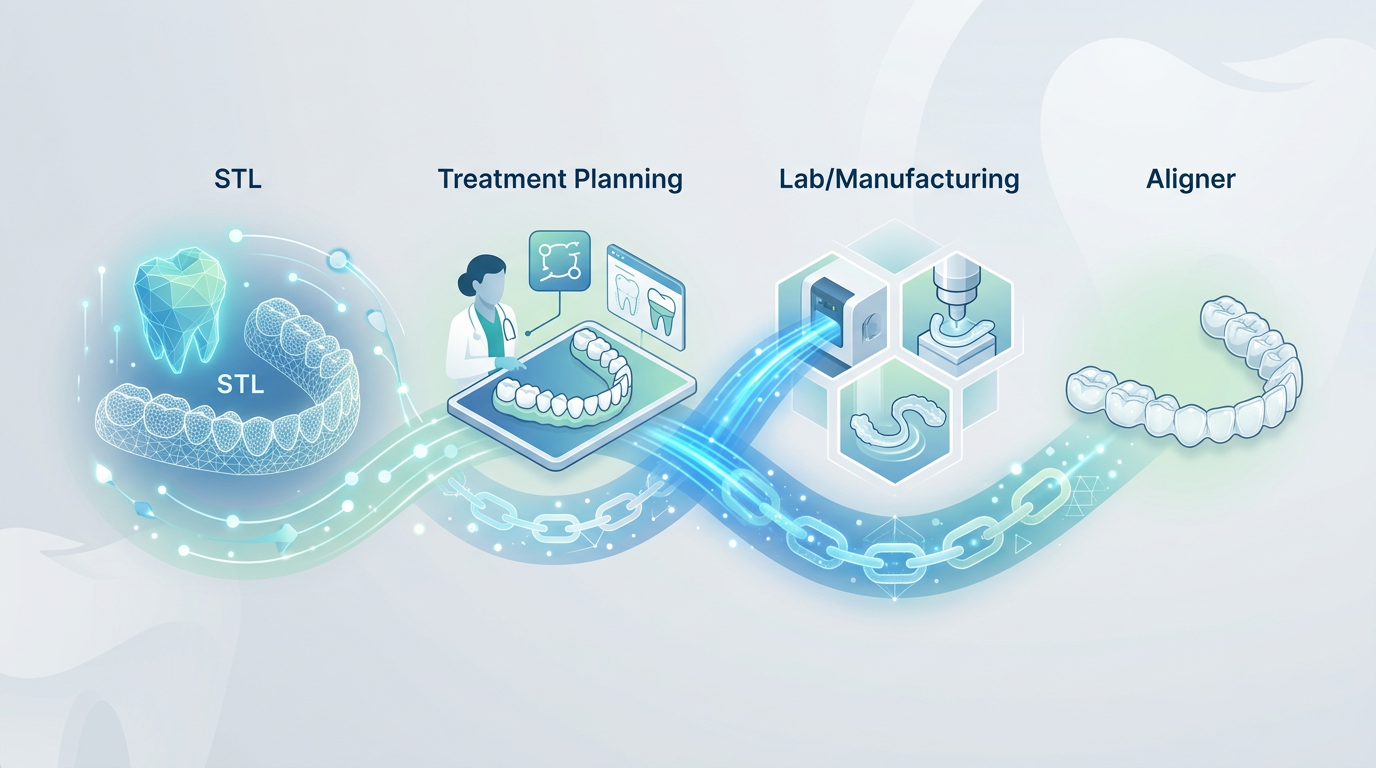
Digital aligner treatment is often marketed as a fast and automated process. In reality, it is a sophisticated multi-step workflow that requires precise coordination between clinicians, treatment planners, labs, and manufacturing systems. Each stage of this process is dependent on the quality of the one preceding it.
When this workflow is not clearly understood or maintained, significant problems emerge. Clinics and labs face avoidable delays, high revision rates, and inconsistent clinical outcomes. Understanding the full pipeline from the initial scan to the final product allows your team to identify where value is created and exactly where it is lost.
The structure of the digital aligner workflow
At a high level, the digital workflow moves through five distinct stages. These stages are scan and data capture, case setup and treatment planning, clinical review and approval, manufacturing and production, and finally, delivery and patient treatment.
Because these stages are tightly connected, a breakdown in one area affects everything downstream. For example, a minor error during the data capture phase can lead to a complete manufacturing failure weeks later. Transitioning from a series of isolated tasks to a cohesive system is the first step toward scaling production.
1. Scan and data capture
The process begins at the clinic. Using intraoral scanners, clinicians capture the foundational data required for the entire case. This includes 3D dental scans (STL files), bite registration, clinical photos, and specific treatment notes. These inputs define the starting point and the limitations of the treatment.
Issues at this stage usually involve poor scan quality, missing clinical context, or incomplete patient records. These deficiencies lead to misaligned digital setups and increased revision cycles before the planning stage even begins. If the planner does not have a clear picture of the patient's current state, they cannot accurately map the path to the desired outcome.
Key insight: The quality of the final aligner is directly tied to the quality of the initial scan. Technology cannot compensate for a lacks of data at the source.
2. Case setup and treatment planning
This is the phase where treatment planners translate clinical intent into a step-by-step digital model. Using CAD software, planners segment teeth, define movement stages, plan attachments, and calculate interproximal reduction (IPR). This stage is not merely a technical task: it is an exercise in clinical interpretation and biomechanical planning.
Treatment planners add the most value by balancing efficiency with biological limits and anticipating potential issues before they occur. However, this is also where many workflows fail. Unclear clinical instructions and a lack of standardization between the clinician and the planner lead to suboptimal plans and longer turnaround times.
The impact of revisions
Industry-wide research suggests that high revision rates are often driven by workflow fragmentation rather than a lack of technical skill. When the communication between the clinic and the planner is unguided, the planner is forced to guess the clinician's preferences.
The fix: Use standardized prescription forms and clear clinical protocols to ensure planners receive actionable instructions. This reduces the need for "back and forth" communication.
3. Clinical review and approval
Once the digital plan is ready, it returns to the clinician for a final review. The clinician evaluates the treatment approach, the final outcome simulation, and the specific placement of attachments. They may approve the plan, request specific revisions, or provide additional instructions.
This stage is frequently a major bottleneck. When feedback is provided outside the structured workflow (such as via scattered emails or phone calls), things get lost in translation. Because a significant portion of cases require at least one revision, the efficiency of this iterative loop determines your overall turnaround time.
4. Manufacturing and production
Once a plan is approved, it moves into the physical production phase. This involves generating individual aligner stages, 3D printing the models, thermoforming the aligners, and final trimming and finishing. While this stage is highly standardized and increasingly automated, it remains vulnerable to upstream errors.
Last-minute changes or file inconsistencies can halt a production line. Most production issues actually originate earlier in the planning phase. Manufacturing does not create these problems: it merely exposes them. If a file is not "manifold" or if the staging is too aggressive for the physical material, the manufacturing process will fail.
Tip: Ensure your treatment planning software outputs are fully compatible with your 3D printing and thermoforming hardware to avoid file conversion errors.
5. Delivery and patient treatment
The final stage involves shipping the aligners to the clinic for delivery to the patient. The clinician then monitors progress, manages patient compliance, and makes adjustments if the teeth do not track as planned. If the treatment does not track, it often necessitates mid-course corrections or additional aligners.
These "refinements" often trace back to the planning stage. If the tooth movements planned in the CAD software were not biologically realistic, the physical teeth will not follow the digital path. This highlights the importance of the planner's role in the entire lifecycle of the case.
Coordination: The hidden layer
While these five steps appear linear, the reality is more complex. Each stage requires coordination between different roles and systems. Today, much of this coordination happens through fragmented channels like messaging apps or shared drives. This lack of a centralized "source of truth" creates delays and reduces visibility for all parties.
Value is created through high-quality scans, accurate planning, and clear clinical decisions. Value is lost through poor inputs, unstructured communication, and excessive revisions. By shifting the focus from individual tasks to the coordination between them, labs and clinicians can significantly improve their margins.
The central role of the treatment planner
Treatment planners sit at the very center of this workflow. They are the link between clinical intent, digital design, and manufacturing readiness. Their influence extends to the quality of the treatment, the number of revisions required, and the speed of delivery.
Success in digital dentistry does not depend on a single piece of software or a specific 3D printer. It depends on how well the entire workflow operates as a system. CaseBench provides the marketplace and structure to ensure this flow remains seamless, connecting clinical needs with professional planning expertise.
Understanding the end-to-end process allows you to optimize the flow between steps rather than just the steps themselves. When the system works, the transition from STL to aligner is predictable, profitable, and, most importantly, effective for the patient.
Want to learn more?
Join CaseBench and be part of shaping the future of digital treatment planning workflows.