Key Takeaways
- 1Prescriptions have become the primary source of truth in digital workflows, so completeness matters more than ever.
- 2Define boundaries and acceptable compromises, not just treatment goals.
- 3Staging philosophy and attachment/IPR preferences should be stated even at a high level.
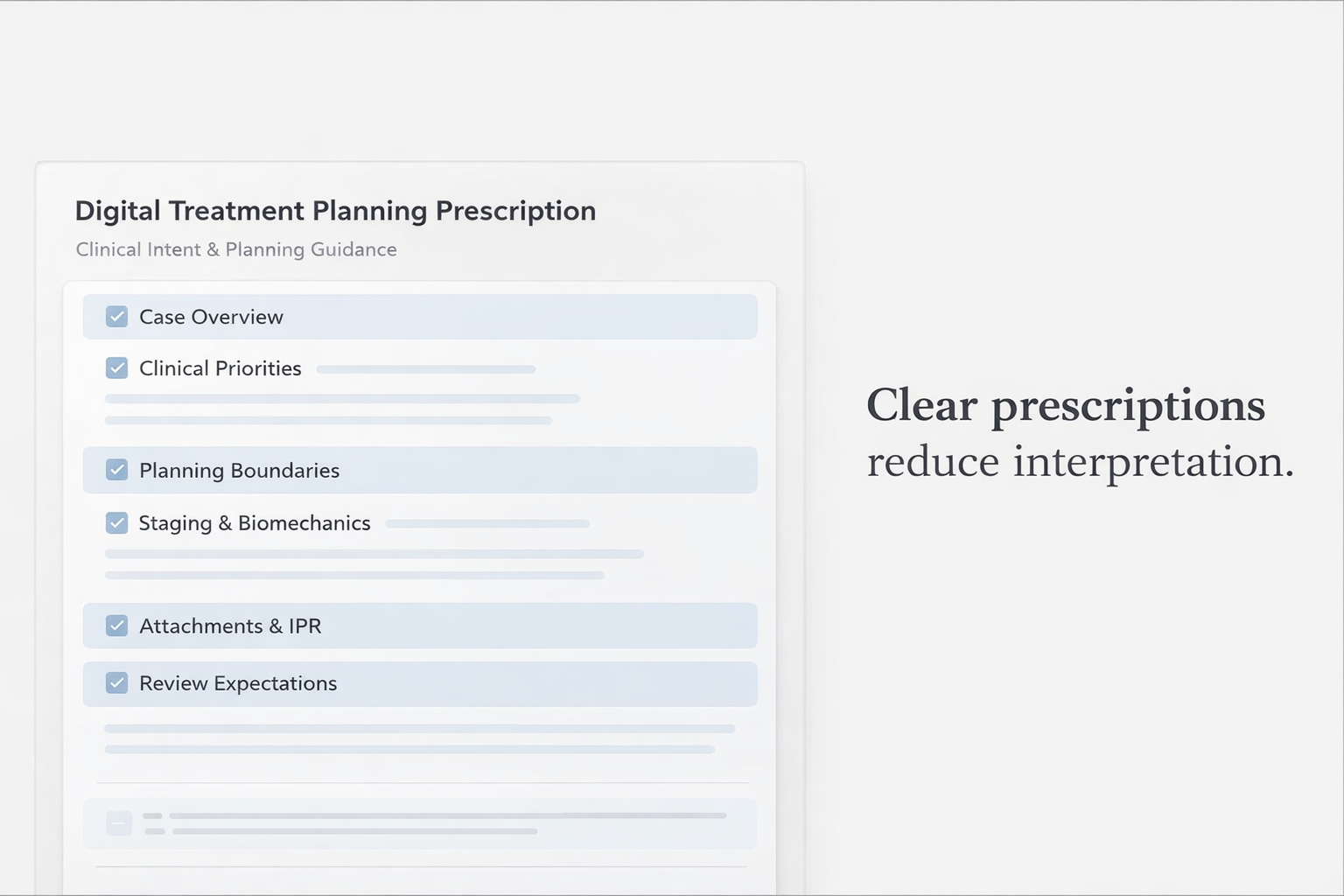
- 4A "revision-resistant" prescription includes core intent, planning boundaries, execution guidance, and review expectations.
- 5Clear prescriptions reduce revisions for everyone by removing ambiguity.
In digital orthodontics, most revision cycles don't come from poor planning or poor clinical judgment. They come from gaps between intent and interpretation.
As workflows become more digital and more distributed, prescriptions are often the only place where clinical intent is captured. When that intent is incomplete, or left open to interpretation, planners are forced to make assumptions. Even highly experienced planners will pause, clarify, or revise when they're unsure how closely a setup aligns with what you had in mind.
The result is familiar:
- Extra review rounds
- Longer turnaround times
- Frustration on both sides
The good news is that many of these revisions are preventable with small, structural changes to how prescriptions are written. This isn't about adding more admin. It's about making your clinical intent easier to execute the first time.
Why Prescriptions Matter More Than Ever
In traditional in-house workflows, intent could be clarified informally: over a desk, a quick conversation, or iterative back-and-forth.
In modern digital workflows:
- Planners may be remote
- Work is asynchronous
- Files move through multiple systems
- Decisions are documented, not discussed
That means the prescription has become the primary source of truth.
Key insight: When key elements are missing, planners don't fail, they pause. And pauses turn into revisions. (For more on tracking where revisions originate, see our article on reducing avoidable revisions.)
The Most Common Prescription Gaps (And Why They Cause Revisions)
These gaps are extremely common, even among experienced clinicians:
1. Clear Objectives vs Acceptable Ranges
Planners often receive:
- "Improve alignment"
- "Align as conservatively as possible"
What helps more is defining boundaries, not just goals:
- What compromises are acceptable?
- Where should the planner stop rather than push further?
Without this, planners may either over-treat or under-deliver, both leading to revision requests.
2. Staging Philosophy (Even at a High Level)
You don't need to micromanage staging. But planners benefit greatly from knowing:
- Whether you prefer conservative vs assertive staging
- If you're prioritising predictability over speed
- Whether refinements are expected or ideally avoided
When this isn't stated, planners default to their own assumptions, which may differ from yours. (For more on staging best practices, see our article on common clear aligner planning mistakes.)
3. Attachment and IPR Intent
When attachments or IPR are not mentioned, planners must infer:
- Whether minimal, functional, or comprehensive approaches are preferred
- Whether certain movements should be avoided
Even a short line clarifying your general approach reduces back-and-forth significantly.
4. Review Expectations
Some clinicians prefer:
- A planner-led proposal with clinical discretion
Others prefer:
- A conservative first pass for tighter review
If this isn't clear, planners may err on the side of caution, or ambition, neither of which may match your expectations.
What a "Revision-Resistant" Prescription Looks Like
Effective prescriptions don't need to be long. They need to be explicit in the right places.
A strong structure includes:
Core Clinical Intent
- Primary treatment objective
- Any non-negotiables
- Known constraints (biomechanical, compliance, aesthetic)
Planning Boundaries
- Acceptable vs non-acceptable compromises
- Preferred staging philosophy
- Flexibility allowed to the planner
Execution Guidance
- Attachment and IPR preferences (high-level)
- Areas where planner judgment is encouraged
- Areas requiring explicit review
Review Expectations
- What constitutes an "acceptable first pass"
- Whether minor deviations can be auto-approved or should return for review
The payoff: This gives planners enough context to make clinically aligned decisions without guessing. (For more on how communication impacts revisions, see our article on communication best practices.)
Why This Helps Everyone
For Clinicians:
- Fewer review rounds
- Faster case starts
- Less time re-explaining intent
For Planners:
- Clearer decision space
- Less rework
- Higher confidence in execution
For Patients:
- Faster treatment initiation
- Fewer delays
- More predictable outcomes
This is not about controlling planners more tightly. It's about removing ambiguity so expertise can be applied effectively.
A Final Note on Collaboration
High-performing digital workflows treat prescriptions as a conversation starter, not a rigid order form.
When prescriptions clearly communicate intent, planners can:
- Focus on quality
- Anticipate preferences
- Surface meaningful questions early
The result: Fewer revisions, not because anyone worked harder, but because the system worked better.
Ready to Streamline Your Workflow?
CaseBench connects clinicians with experienced treatment planners who understand how to execute clear prescriptions efficiently.