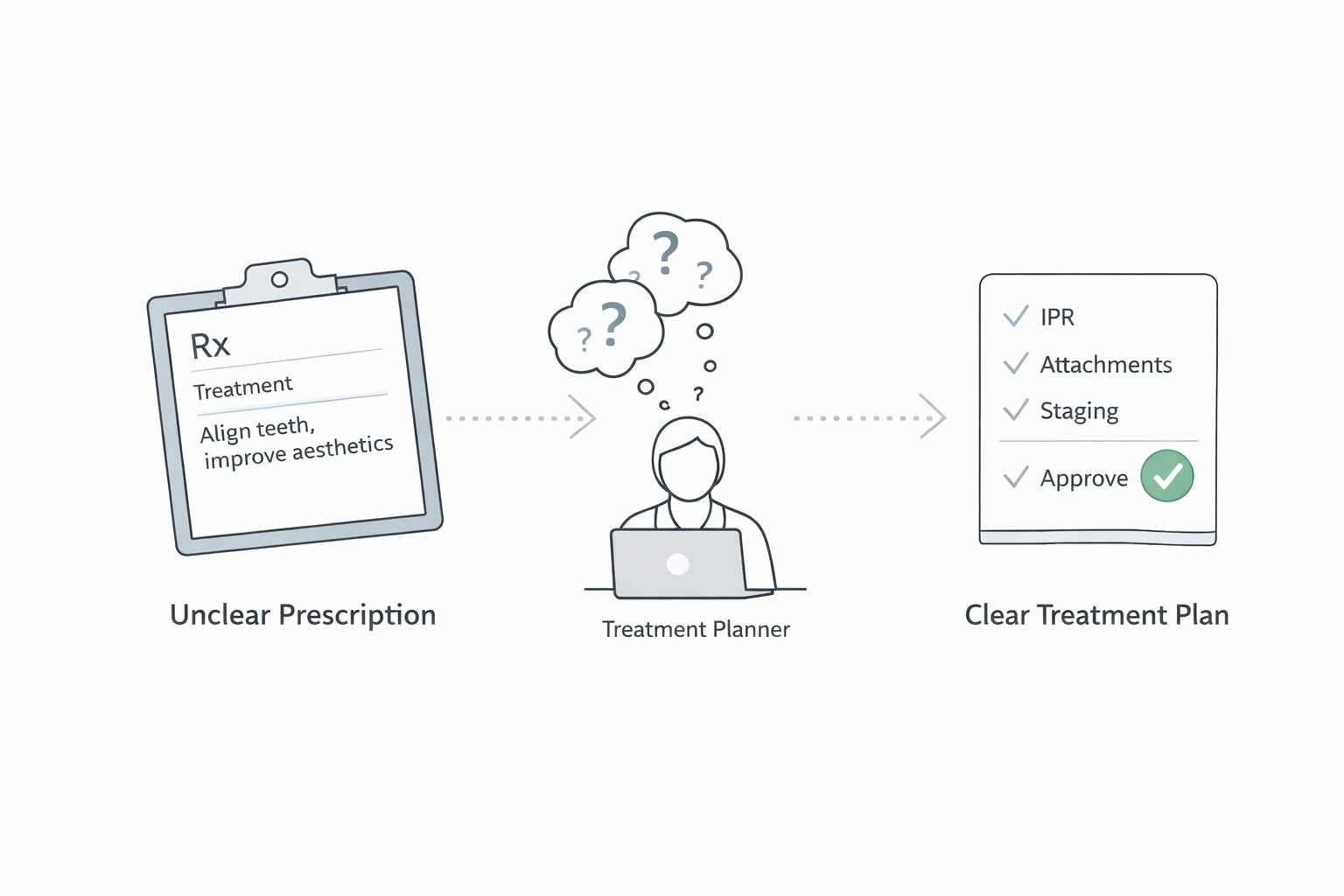
Key Takeaways
- 1Unclear prescriptions are usually incomplete, not wrong. The gap is in priorities, constraints, and preferences.
- 2Designing on assumptions without stating them is the fastest path to avoidable revisions.
- 3One or two well-framed questions before planning starts can prevent multiple revision rounds.
- 4Making assumptions visible turns hidden decisions into shared ones, reducing surprise-driven revisions.
- 5Most revision-heavy workflows are caused by decisions being made too late, not by poor planning.
Most treatment planners will recognise this situation. A case arrives with scans and a short prescription that states the outcome, but very little about priorities, constraints, or preferences. The plan can technically be designed, but there is a high risk it will come back for revisions.
This is not uncommon, and it is not always a sign of poor clinical intent. Many clinicians assume certain decisions are implied, while planners assume flexibility that was never explicitly agreed.
The challenge for planners is not how to "fix" the prescription, but how to work professionally within the uncertainty without creating unnecessary revisions.
What Makes a Prescription "Unclear"
Before going further, it is important to be clear about what we mean by a "bad" prescription.
In most cases, prescriptions are not wrong. They are incomplete.
They often describe the end goal but leave out:
- Priorities between movements
- Preferences around attachments or IPR
- Staging expectations
- Constraints that affect feasibility
Key point: When these gaps are not addressed early, planners are forced to guess. Revisions then become inevitable. (For more on how assumptions lead to revisions, see our article on reducing avoidable revisions.)
Why Unclear Prescriptions Create Revision-Heavy Workflows
Unclear prescriptions push decision-making downstream. Instead of decisions being made before planning starts, they are deferred until the clinician sees the setup.
This leads to:
- Late preference changes
- Rework that could have been avoided
- Frustration on both sides
- Delays that affect labs and manufacturing
Important: These revisions are rarely caused by poor planning. They are caused by misaligned assumptions.
What Planners Should Not Do
When faced with an unclear prescription, planners often default to one of two unhelpful approaches.
The first is designing based on assumptions and hoping the clinician agrees. This may save time initially, but it almost always results in revisions later.
The second is overcorrecting by sending long messages or excessive questions, which can slow the workflow and overwhelm the clinician.
Neither approach solves the underlying problem. (For more on finding the right communication balance, see our article on communication best practices for treatment planners.)
A Better Approach: Clarify Intent, Not Instructions
The goal is not to extract a perfect prescription. The goal is to clarify clinical intent and decision boundaries.
Before starting design, planners should aim to confirm:
- The primary treatment goal
- Any hard constraints
- Where the planner has decision freedom
This can often be done with one or two well-framed questions. For example:
"I'll proceed with posterior anchorage and staged IPR unless you'd prefer a different approach."
This does three things at once. It reflects intent, proposes a solution, and invites correction without confrontation.
Make Assumptions Visible
One of the most effective communication techniques planners can use is stating assumptions clearly.
Instead of silently deciding, planners should say what they are assuming and why. Examples include:
"Proceeding with minimal attachments to prioritise aesthetics."
"Assuming IPR is acceptable on 12 and 22 to reduce expansion."
"Staging movements conservatively to reduce tracking risk."
The payoff: Making assumptions visible turns hidden decisions into shared ones. This dramatically reduces surprise-driven revisions.
Use the First Submission as a Decision Checkpoint
When prescriptions are unclear, the first submission becomes even more important.
A strong first submission should include:
- A brief summary of key decisions made due to limited instruction
- A short explanation of trade-offs
- One clear confirmation question
For example:
"Please confirm you are comfortable with the attachment strategy and IPR timing before proceeding."
This reframes feedback as approval rather than redesign. (For more on how prescriptions shape outcomes, see our article on how clear prescriptions lead to fewer revisions.)
Set Professional Boundaries Without Being Difficult
Planners are allowed to pause work when critical information is missing. This is not being difficult. It is protecting the workflow.
Professional boundaries include:
- Asking for clarification before redesigning
- Flagging when changes affect timelines or manufacturing
- Requesting consolidated feedback
Clear boundaries prevent repeated revision cycles and protect planner time. (For more on avoiding common workflow mistakes, see our article on common clear aligner planning mistakes.)
Remember That Communication Is Shared Responsibility
Prescriptions sit at the intersection of clinical intent and technical execution. When they are unclear, it is rarely one person's fault.
Clinicians may not realise which decisions affect planning complexity. Planners may not always see the clinical priorities behind a short instruction.
Better outcomes come from treating prescriptions as the start of a conversation, not a handoff.
Closing
Working with unclear prescriptions is part of treatment planning. The goal is not to eliminate uncertainty, but to manage it professionally.
By clarifying intent early, making assumptions visible, and using structured communication, planners can reduce revisions without increasing workload or tension.
The bottom line: Most revision-heavy workflows are not caused by poor prescriptions or poor planning. They are caused by decisions being made too late.
Ready to Work With Better Workflows?
CaseBench connects treatment planners with labs and clinicians who value clear communication and efficient case management.